


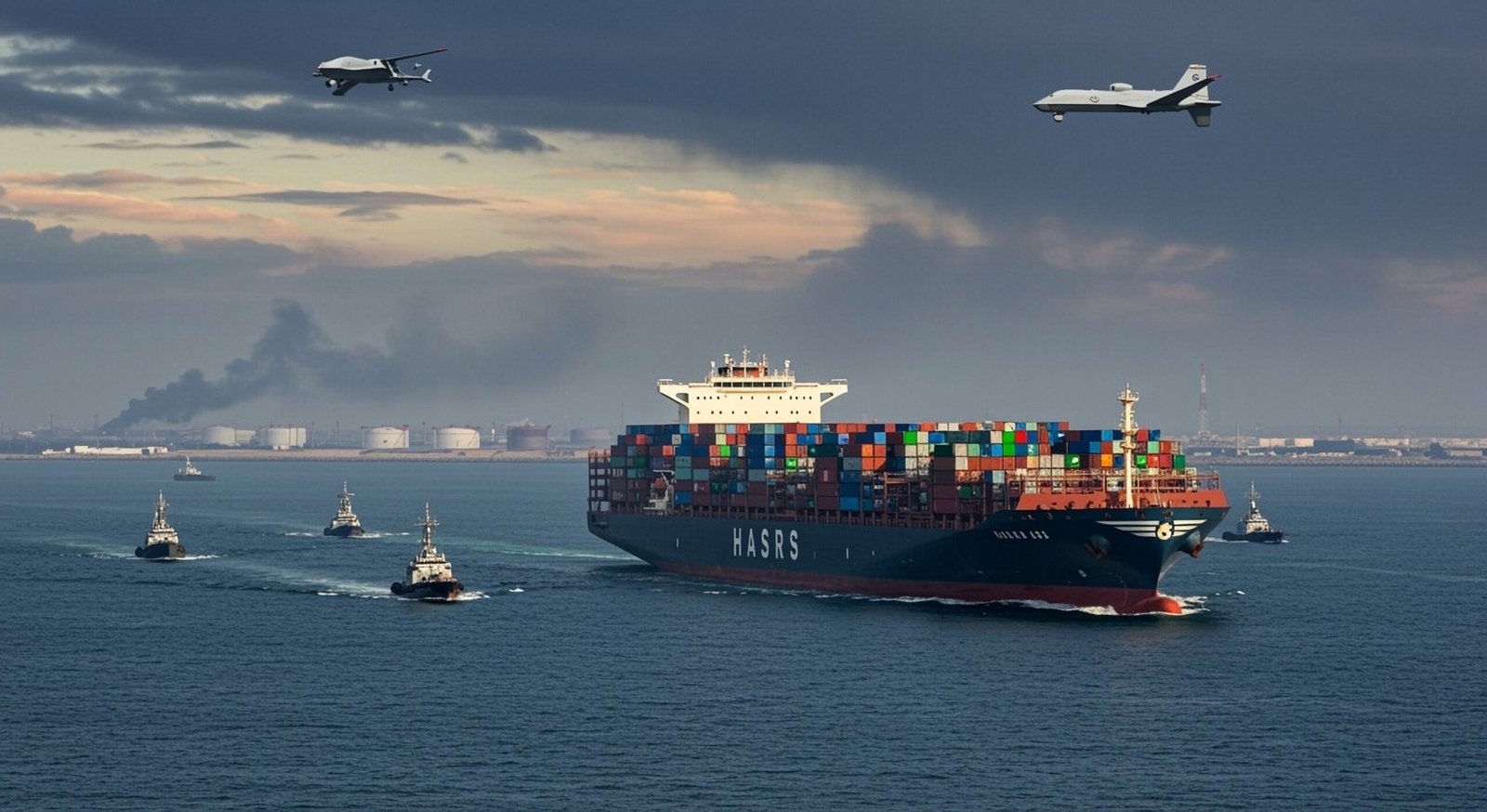
Blocking the Strait of Hormuz has been discussed in Iran for four decades, particularly since the Iran-Iraq war and the so-called “Tanker War” in the 1980s. Although Tehran never implemented a full closure during that period, the concept remained part of Iranian strategic thinking. Following the end of the war, Iran gradually developed a long-term strategy and the military capabilities necessary to influence, control, and potentially restrict maritime traffic through the Strait.
The Islamic Revolutionary Guard Corps (IRGC) Navy plays a key role in securing, monitoring, and controlling passage through the Strait of Hormuz. Its capabilities include naval bases, radar and surveillance systems, cruise and ballistic missiles, drones, frigates, speedboats, logistical facilities, inspection and seizure capabilities, and naval mines. Together, these assets have enabled Iran to exercise an unprecedented degree of influence over maritime traffic in the Strait for the past three months.
As a result, the Strait of Hormuz has emerged as a new element in the broader confrontation between Iran and the United States alongside the nuclear issue, missile deveklopment, proxy groups, and sanctions. This development has added a further layer of complexity to both tensions and negotiations between the two countries. U.S. Secretary of State Mark Rubio recently described the Strait of Hormuz as an “economic nuclear weapon”.[i]
While the United States, the Gulf Arab states, and the European Union maintain that the Strait, as an international waterway, must remain open to all ships without transit fees, Iran argues that the U.S.-Israeli war – and particularly the use of U.S. military facilities in Gulf countries – has fundamentally changed this reality. From Tehran’s perspective, the combination of sanctions, maritime interdictions, and economic pressure constitutes a form of economic and maritime blockade, strengthening Iran’s determination to control access to the Strait.
Iranian officials have increasingly emphasized that the status quo that existed before will not be simply restored. Brigadier General Abolfazl Shekarchi, spokesman for the General Staff of the Armed Forces, stated that “the Strait of Hormuz will not return to its pre-war state”.[ii] Similarly, Ali Nikzad, Deputy Speaker of Parliament, declared that the “Strait of Hormuz will not return to its original state.”
Beyond rhetoric, Iran has also pursued institutional measures. These include the drafting of a “Strategic Action Plan for Peace and Sustainable Development of the Persian Gulf Region”,[iii] which remains under parliamentary consideration, and the establishment of “The Persian Gulf Strait Authority (PGSA)” on 5 May. Although the Authority has already been sanctioned by the United States, its creation reflects Tehran’s broader effort to institutionalize its role in the management of the Strait. Some Iranian analysts argue that the leverage from control of the Strait now exceeds the value of more than 400 kilograms of uranium enriched above 60% or Iran’s missile capabilities.
Maritime leverage and the logic of negotiation
Over the past three months, Iran’s approach in the Strait of Hormuz has effectively taken three forms. First, restrictions have been imposed on vessels associated with countries considered hostile, including Israel, the United States, and states hosting U.S. military bases. Second, vessels from neutral countries such as Japan, South Korea, and Singapore have reportedly been permitted to transit subject to various arrangements. Third, vessels from countries regarded as friendly, including Iraq, Pakistan, Russia, and China, have generally encountered fewer restrictions.
At the same time, the reopening and normalization of traffic through the Strait appears inseparable from the broader dispute between Tehran and Washington. From Iran’s perspective, U.S. sanctions on oil exports, banking transactions, shipping, and maritime commerce collectively amount to a form of economic and maritime blockade. Under these circumstances, Tehran is unlikely to support a full restoration of unrestricted traffic. Conversely, the U.S. and its regional partners are unlikely to support the termination of economic and maritime restrictions against Iran without guarantees regarding maritime security and the uninterrupted flow of global trade.
As a result, any future understanding between the parties would likely be based on reciprocal commitments. Iran would provide guarantees regarding maritime security and the normalization of commercial shipping, while the United States would reduce or remove selected maritime, financial, energy, and economic restrictions imposed on Iran.
Neither side appears willing to move first without receiving tangible concessions from the other. Iran will seek verifiable sanctions relief and meaningful access to its financial resources. The U.S. will seek practical evidence that maritime security has been restored and that tensions in the Strait have diminished. The relationship between these two issues is not merely simultaneous but strategically interdependent. The normalization of maritime traffic and the easing of economic pressure on Iran most likely proceed through a phased and synchronized process rather than through unilateral actions by either side.
The debate over transit fees
Tehran is also seeking recognition of its role as a provider of security and a manager of maritime traffic in one of the world's most strategically important waterways.
When the various reports and proposals are considered collectively, it appears that Iran’s objectives extend beyond reopening the Strait. Tehran is also seeking recognition of its role as a provider of security and a manager of maritime traffic in one of the world’s most strategically important waterways. Within this framework, revenue generated from transiting vessels could be presented as compensation for security provision, maritime monitoring, navigational assistance, and traffic management services. However, this presents a fundamental challenge.
From Iran’s perspective, if maritime security, mine-clearance operations, navigational guidance, inspections, and traffic-management services are provided – potentially in cooperation with Oman – then charging fees for such services would be justified. The United States, major shipping companies, and many maritime legal experts, however, maintain that imposing direct transit charges simply for passage through the Strait would conflict with the principle of freedom of navigation in international waterways. As a result, future negotiations are likely to focus not only on whether payments are made, but also on how such payments are legally defined and structured.
Three potential scenarios can be envisioned:
Scenario one: Direct transit tolls
Under this model, every vessel transiting the Strait of Hormuz would be required to pay a fixed transit fee, similar to arrangements governing the Suez Canal or Panama Canal. This appears to be the least likely outcome. The United States has openly opposed such a system and has warned against any attempt to establish a formal toll-collection regime in the Strait.
Scenario two: Navigation and security service fees
Under this model, Iran would not formally charge transit tolls. Instead, vessels would pay for charge fees for specific services such as pilotage, maritime escort operations, navigational assistance, traffic management, and safety inspections. From a legal standpoint, this model is considerably more defensible because international law generally distinguishes between fees charged for identifiable services and tolls imposed simply for the right of passage. This position is broadly consistent with recent comments by Iranian officials, including Deputy Foreign Minister for Legal and International Affairs Kazem Gharibabadi, who has argued that that any fees would be linked to services provided by Iran and Oman.
Scenario three: Indirect economic compensation
Under this scenario, Iran would refrain from collecting formal transit fees. In return, however, a portion of its frozen assets would be released, oil exports could increase, shipping and insurance restrictions would be eased, and broader economic pressure could be reduced. Rather than receiving direct payments from vessels, Tehran would benefit indirectly through the economic gains associated with the normalization of maritime traffic and improved access to international markets. This scenario is also consistent with reports suggesting that formal transit fees could ultimately be abandoned as part of a wider political and economic agreement. This appears to be the most plausible scenario.
Conclusion
Before the recent forty-day war, many observers questioned whether Iran possessed the practical capability to block the Strait of Hormuz. The events of the past several weeks have significantly altered that assessment. Iran’s demonstrated ability to disrupt maritime traffic and exert control over the Strait has transformed what was once viewed as a primarily theoretical threat into a tangible strategic reality.
As a result, the Strait has become one of Tehran’s most important sources of leverage. It now plays a central role in ceasefire dynamics, maritime security calculations, sanctions negotiations, and any prospective agreement between Iran and the U.S.
Whether a return to war would alter this equation remains uncertain. In fact, it could further complicate the situation, potentially involving expanded mine-laying operations, broader disruptions in the Gulf, and even the simultaneous closure of both the Straits of Hormuz and the Bab el-Mandeb.
[i] Fox News (2026). “Rubio says Strait of Hormuz is equal to an economic nuclear weapon”, 27 April 2026, retrieved from: https://www.foxnews.com/video/6394028049112.[ii] ABNA 24 (2026). “Strait of Hormuz situation will not return to previous state: Iran Armed Forces”, 27 March 2026, retrieved from: https://en.abna24.com/news/1795368/Strait-of-Hormuz-situation-will-not-return-to-previous-state.[iii]. Tabnak (2026). “Iranian MPs preparing plan on strategic management of Hormuz Strait”, 25 April 2026, retrieved from: https://www.tabnak.ir/en/news/7355/iranian-mps-preparing-plan-on-strategic-management-of-hormuz-strait