

Navigating Steady Seas: Global Dry Bulk Shipping Market to Surpass US$ 100 Billion by 2035


- Details
- Category: Mercados - Fletes- Cotizaciones
- Published on Thursday, 06 November 2025 23:32
- Written by Administrator2
- Hits: 271
| TMR Research
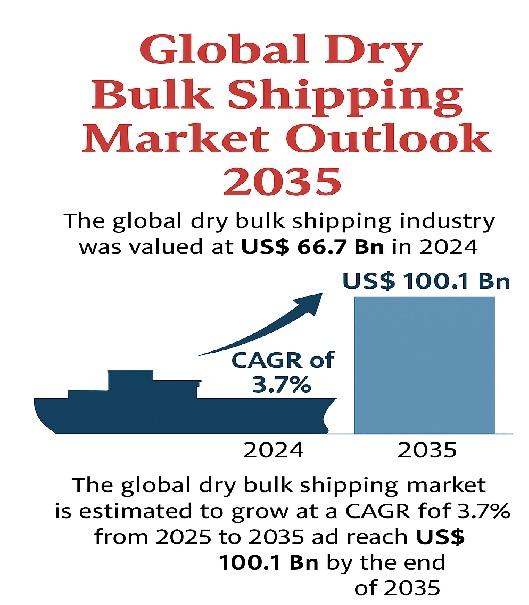
Dry Bulk Shipping Market
Dive Deeper into Data: Get Your In-Depth Sample Now!
https://www.transparencymarketresearch.com/sample/sample.php?flag=S&rep_id=77865
Understanding the Dry Bulk Shipping Market
Dry bulk shipping involves the transportation of unpackaged bulk commodities-such as iron ore, coal, grains, bauxite, cement, fertilizers, and steel-via specialized vessels known as bulk carriers. These commodities form the backbone of industries including construction, manufacturing, agriculture, and energy, making bulk shipping a vital component of global trade.
Unlike containerized cargo, dry bulk goods are transported in large quantities directly in the ship's hold. The efficiency and cost-effectiveness of this shipping method have made it the preferred choice for long-distance transport of raw materials, especially between resource-rich and industrialized regions.
The market is segmented by vessel type (Capesize, Panamax, Supramax, and Handysize) and cargo type, each catering to specific trade routes and commodity demands. The evolution of larger, more fuel-efficient ships, coupled with digital logistics solutions, is helping operators enhance profitability and reduce operational risks.
Market Drivers
1. Global Industrial and Infrastructure Growth
Rapid industrialization, particularly in Asia-Pacific and Africa, continues to drive the demand for raw materials like iron ore, coal, and cement-all key commodities transported by bulk carriers. China, India, and Southeast Asia are spearheading infrastructure expansion with megaprojects in urban construction, renewable energy, and transportation networks, fueling consistent demand for dry bulk shipping.
The global steel industry, a major consumer of iron ore and coal, has seen steady recovery post-pandemic, further supporting shipping demand. Similarly, agricultural commodity trade-particularly wheat, corn, and soybeans-remains robust as global food consumption and exports increase.
2. Resilient Commodity Trade and Economic Interdependence
Despite economic uncertainties, the interdependence of global supply chains ensures that bulk shipping remains indispensable. Energy transition trends are shifting demand patterns, with coal shipments stabilizing while bauxite, alumina, and biomass trade volumes rise. The diversification of cargo types is helping shipping operators maintain balance across market cycles.
In addition, emerging economies are investing heavily in port infrastructure to handle higher cargo volumes efficiently, reducing turnaround time and increasing vessel utilization rates.
3. Technological Modernization and Fleet Optimization
The dry bulk shipping industry is undergoing digital and technological transformation. Fleet operators are adopting AI-based route optimization, predictive maintenance systems, and fuel-efficient propulsion technologies to improve cost efficiency and sustainability.
The trend toward eco-friendly vessel design-including LNG-powered and hybrid bulk carriers-aligns with the International Maritime Organization's (IMO) decarbonization targets. As regulatory pressure for emission reduction intensifies, shipowners are upgrading fleets to comply with stricter environmental norms.
4. Rising Agricultural Exports and Food Security Trade
The growing global population and food security initiatives are boosting grain and fertilizer trade. Countries like the U.S., Brazil, Argentina, Ukraine, and Australia dominate agricultural exports, while import demand from Asia and Africa continues to surge. The resulting trade flow is significantly benefiting the Handysize and Supramax vessel segments that specialize in carrying agricultural bulk.
Market Challenges
Despite its positive outlook, the dry bulk shipping market faces several challenges:
Volatile Freight Rates: Rates are influenced by supply-demand imbalances, fuel prices, and seasonal commodity cycles.
Environmental Regulations: IMO 2023 carbon intensity targets are pushing operators to invest in cleaner technologies, which can increase operational costs.
Geopolitical Tensions: Trade disruptions, port congestions, and regional conflicts can affect key shipping routes and raise insurance and fuel expenses.
Aging Fleet Replacement: Many bulk carriers are nearing end-of-life, requiring significant capital investment for fleet renewal and modernization.
However, these challenges are spurring innovation-leading to smarter fleet management, improved fuel efficiency, and digital transformation across maritime logistics.
To Know more About Report - https://www.transparencymarketresearch.com/dry-bulk-shipping-market.html
Competitive Landscape
The dry bulk shipping industry is highly fragmented, with major operators focusing on fleet expansion, modernization, and route diversification. Key players include:
Berge Bulk
Golden Ocean Group Ltd.
Oldendorff Carriers
Star Bulk Carriers
Navios Maritime Partners
Maran Dry Management
Pacific Basin Shipping Limited
Genco Shipping & Trading Ltd.
Diana Shipping
Safe Bulkers
Other Players
Regional Insights
Asia-Pacific: The Global Shipping Powerhouse
The Asia-Pacific region continues to dominate the dry bulk shipping market, led by China, Japan, South Korea, and India. China remains the largest importer of iron ore and coal, while India's growing steel and cement sectors are increasing import demand. Emerging economies in Southeast Asia are also boosting intra-regional bulk trade due to industrial growth and construction booms.
Europe
Europe plays a crucial role in agricultural and energy commodity trade. The transition toward renewable energy and sustainable building materials is reshaping dry bulk demand patterns, particularly in northern and western Europe.
North America
The U.S. remains a leading exporter of agricultural products, contributing significantly to global grain trade. The shale gas boom has indirectly influenced dry bulk trade through fertilizer exports and raw material movement.
Latin America and Middle East & Africa (MEA)
Brazil is a top exporter of iron ore and soybeans, making it a critical player in the global dry bulk ecosystem. Meanwhile, Africa's growing mining and construction sectors are fueling outbound shipments of minerals and inbound shipments of cement and fertilizers. The MEA region is also expanding its port infrastructure to attract global trade flows.
Future Outlook: Charting a Sustainable Course
The coming decade will redefine the global dry bulk shipping landscape as sustainability, technology, and resilience take center stage. The transition to low-sulfur fuels, LNG propulsion, and hybrid systems will continue to reshape fleet operations.
Additionally, digitalization-through AI-based freight forecasting, blockchain-enabled documentation, and IoT-driven fleet tracking-will improve operational efficiency and transparency across the shipping value chain.
Explore Latest Research Reports by Transparency Market Research:
Purified Terephthalic Acid (PTA) Market: https://www.transparencymarketresearch.com/purified-terephthalic-acid-pta-market.html
Isopropyl Acetate Market: https://www.transparencymarketresearch.com/Isopropyl-acetate-market.html
Europe Sunflower Husk Pellet Market: https://www.transparencymarketresearch.com/europe-sunflower-husk-pellet-market.html
Formamidinium Iodide Market: https://www.transparencymarketresearch.com/formamidinium-iodide-market.html
About Transparency Market Research
Transparency Market Research, a global market research company registered at Wilmington, Delaware, United States, provides custom research and consulting services. Our exclusive blend of quantitative forecasting and trends analysis provides forward-looking insights for thousands of decision makers. Our experienced team of Analysts, Researchers, and Consultants use proprietary data sources and various tools & techniques to gather and analyses information.
Our data repository is continuously updated and revised by a team of research experts, so that it always reflects the latest trends and information. With a broad research and analysis capability, Transparency Market Research employs rigorous primary and secondary research techniques in developing distinctive data sets and research material for business reports.
Contact Us:
Transparency Market Research Inc.
CORPORATE HEADQUARTER DOWNTOWN,
1000 N. West Street,
Suite 1200, Wilmington, Delaware 19801 USA
Tel: +1-518-618-1030
USA - Canada Toll Free: 866-552-3453
This release was published on openPR.
Permanent link to this press release:
Please set a link in the press area of your homepage to this press release on openPR. openPR disclaims liability for any content contained in this release.