
Navies around the world are facing increasingly complex demands due to expanded operational responsibilities. This includes deploying vessels for various purposes, including anti-submarine warfare, mine countermeasures, logistical support and surface-to-air defense. There is also a growing need for greater interoperability between NATO-friendly countries, which requires vessels to adapt to evolving situations. Taking a modular approach can help ensure mission readiness during rapidly changing times, while also optimizing total cost of ownership (TCO).
The Evolution of Maritime Power
The concept of modularity, which refers to the ability to reconfigure vessels to fulfill various roles as required, is gaining interest globally. This approach allows different compartments (modules) and capabilities to be changed on-demand to accommodate more crew, supplies or ordnance.
From frigates to corvettes, new ships are designed to be multi-mission surface vessels capable of performing several operational roles and adaptable to rapidly changing environments and technologies. However, engine choice underpins modular capabilities, as the technology must provide reliable performance while economizing space and weight.
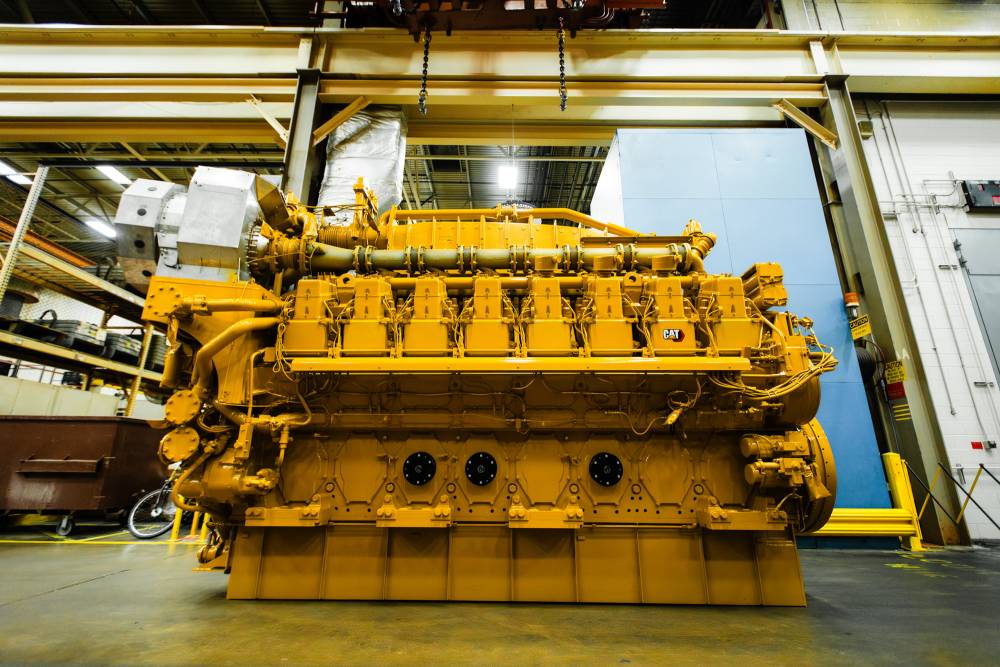
C280-16 – Powering the Navies of Tomorrow
The Cat® C280 engine, a trusted and reliable power source for naval and maritime applications for more than 30 years, has consistently delivered dependable power and performance. C280 solutions have reliably powered frigates and corvettes, and the same 16-cylinder engine platform will be available up to 8 MW of propulsion power and up to 6.6MW electrical when configured in a generator set application. This significantly augments vessel power without altering the size or weight of the engine, maximizing modularity potential.
At sea, obtaining a higher power density in the same 16 -cylinder platform footprint is advantageous. The 8 MW-rated C280-16 is up to 20% lighter than similarly powered engines[1]. As typical naval vessel configurations use two to four engines, the C280-16 can reduce tonnage by 28-50 tons compared to conventional 16-cylinder engines capable of 8 MW output. This substantial weight reduction allows more capacity for additional mission modules and contributes to longer endurance at sea.
Additionally, Caterpillar Marine has built an extensive database of C280 engine performance based on millions of operating hours. Relying on a very robust CPI (continuous product improvement) process, the engineering teams have conducted reliability studies, thus enabling the operator to better schedule the service and maintenance events to their mission profile. Caterpillar and the worldwide dealer network can provide CBM (condition-based maintenance) solutions, advanced analytics and integrated fleet management, supporting the ultimate target to ensure availability of the vessel whenever needed.
The average applications for Navy and Coastguards extend the time between overhauls to 20,000 hours for top-end overhauls and an impressive 40,000 hours for major overhauls. Extending time between overhauls decreases maintenance and parts costs, optimizing mission readiness, uptime, and ultimately total cost of ownership.
The integration of Cat C280-16 engines into the modular design further demonstrates the benefits of versatility and standardized components. The engine's compact design also helps naval engineers design to reconfigure the vessel for different operational requirements and payloads, thus reducing the time and costs associated with maintenance and upgrades. This approach enhances the vessel’s operational readiness and ensures that it can meet the evolving needs of naval applications.
In support of mission readiness and evolving mission requirements, it is worth mentioning that the uprated 8 MW engine supports the use of biodiesel fuel blends up to B1002], and hydrotreated vegetable oil (HVO) at any percentage. Its combustion design meets the demands of the most difficult environments while increasing performance and reliability and potentially reducing lifecycle greenhouse gas (GHG) emissions[3].
Modular Capabilities for Modern Fleets
In the dynamic world of naval operations, modular vessels can offer a strategic advantage by enabling fleets to maintain readiness and respond swiftly to emerging threats. The Cat C280-16 will allow navies around the world to embark on the next mission confidently.
[1] Figures based on comparative study made against 16V engines at 7280 kW MTU 8000 series and MAN V28/33D STC