Associated natural gas production has tripled since 2018 in top three Permian oil plays

- Details
- Category: Energía y Combustibles
- Published on Thursday, 07 December 2023 05:39
- Written by Administrator2
- Hits: 727
Associated natural gas production has tripled since 2018 in top three Permian oil plays
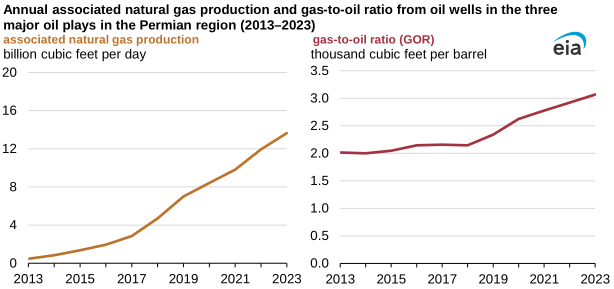
Note: Information on EIA's classification of oil and natural gas wells is available in our Drilling Productivity Report Supplement. The three major oil plays are the Spraberry, Wolfcamp, and Bone Spring plays. Data reflect the average from January through July 2023.
Production of associated-dissolved natural gas, or associated natural gas, which is natural gas produced from predominantly oil wells, has nearly tripled since 2018 in the three top-producing tight oil plays in the Permian region. Associated natural gas from the Wolfcamp, Spraberry, and Bone Spring plays averaged a combined 13.7 billion cubic feet per day (Bcf/d) in the first seven months of 2023, up from an average of 4.7 Bcf/d in 2018, according to data from Enverus DrillingInfo. Associated natural gas production has grown due to increases in both crude oil production and the volume of natural gas per barrel of oil that a well produces, the gas-to-oil ratio (GOR), among the oil wells in these three plays.
Tags: Natural Gas, Wells, Permian, Production/Supply
Countries in the Middle East and North Africa supply about one-third of global LNG
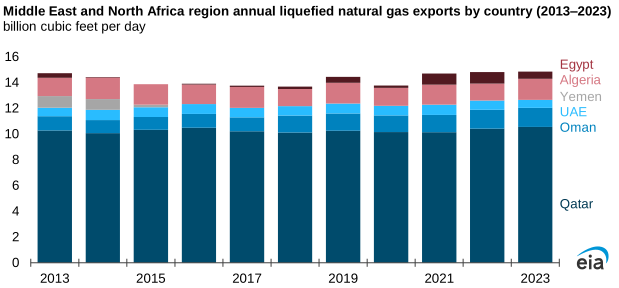
Note: Liquefied natural gas (LNG) exports for 2023 include a nine-month (Jan–Sep) average.
Exporting countries in the Middle East and North Africa region (MENA) supplied nearly one-third (29%) of global liquefied natural gas (LNG) exports in 2022, according to data from the International Group of Liquefied Natural Gas Importers (GIIGNL). The share of global LNG exports coming from the region’s exporters—Qatar, Oman, the United Arab Emirates (UAE), Algeria, and Egypt—declined from 47% in 2013 to about 30% by 2020 because of growing LNG exports from Australia and the United States.
Red Sea chokepoints are critical for international oil and natural gas flows
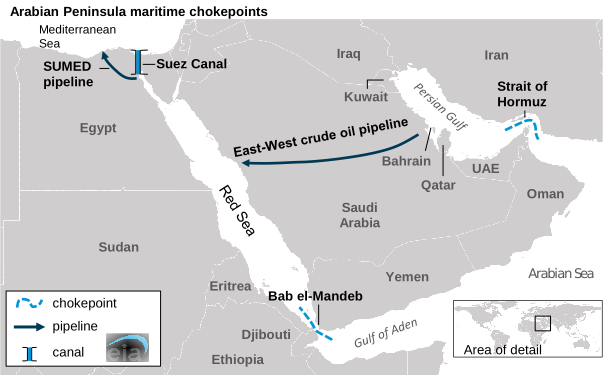
The Suez Canal, the SUMED pipeline, and the Bab el-Mandeb Strait are strategic routes for Persian Gulf oil and natural gas shipments to Europe and North America. Total oil shipments via these routes accounted for about 12% of total seaborne-traded oil in the first half of 2023, and liquefied natural gas (LNG) shipments accounted for about 8% of worldwide LNG trade.
Global CO2 emissions rise through 2050 in most IEO2023 cases
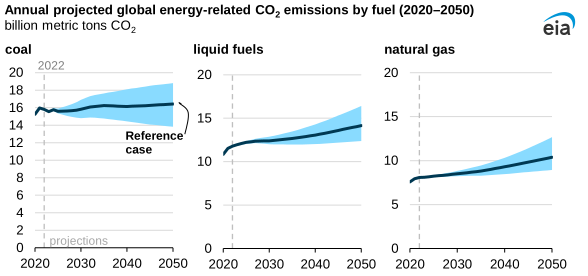
Note: Shaded regions represent maximum and minimum values for each projection year across the IEO2023 Reference case and side cases.
We project that global energy-related CO2 emissions from consumption of coal, liquid fuels, and natural gas will increase over the next 30 years across most of the cases we analyzed in our International Energy Outlook 2023 (IEO2023).
Coal generation decreased in 2022, but overall U.S. emissions increased
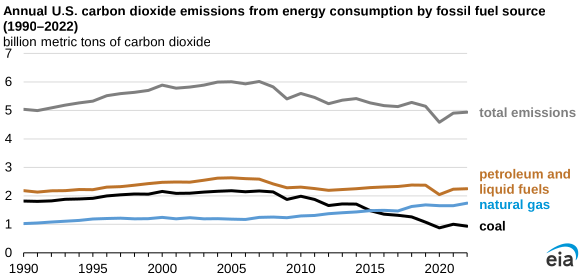
U.S. coal-related CO2 emissions decreased by 7%, or 68 million metric tons (MMmt), in 2022 relative to 2021. This decrease was largely due to an 8% decline in coal-fired power generation because of retiring coal-fired generating capacity. Changes in electricity generation sources decreased the carbon intensity of electricity by 4% in the United States in 2022 as growing natural gas-fired and renewable energy resources and a coal supply shortage contributed to the lower coal-related emissions.
Tags: Coal, Generation, Electricity, Emissions, CO2 (Carbon Dioxide)
Lower CO2 emissions are partially due to shifts in power generation sources
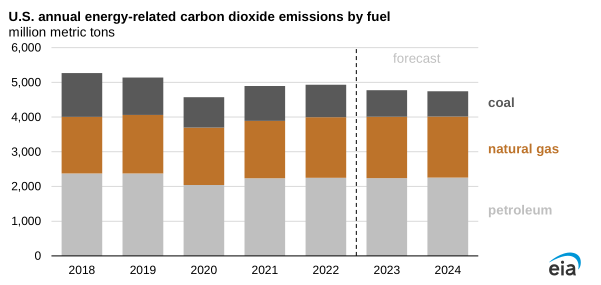
We forecast the U.S. energy sector to emit about 4,790 million metric tons of carbon dioxide (CO2) in 2023, a 3% decrease from 2022. Much of this decline results from lower electricity generation from coal-fired power plants due to higher generation from renewable sources such as solar power. We expect this trend to continue into 2024, with CO2 emissions declining 1% relative to 2023.
Electric vehicles and hybrids grow to a record-high 18% of U.S. light-duty vehicle sales
Reposted to correct data errors.
Note: 3Q23 = third quarter of 2023
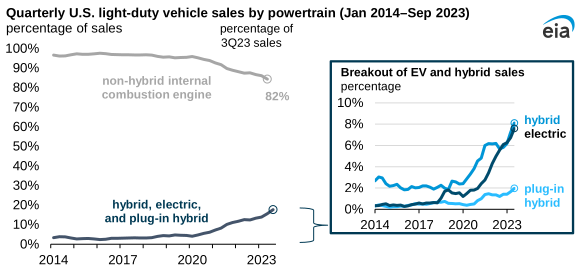
Sales of hybrid, plug-in hybrid, and battery-electric vehicles (BEV) in the United States rose to 17.7% of new light-duty vehicle sales in third-quarter 2023, according to data from Wards Intelligence. Sales of hybrids, plug-in hybrids, and BEVs have accounted for 16.0% of all new light-duty vehicle sales in the United States so far this year, compared with 12.5% in 2022 and 9.0% in 2021.
Tags: Electricity, Vehicles
U.S. gasoline prices decline amid lower gasoline demand and falling crude oil prices
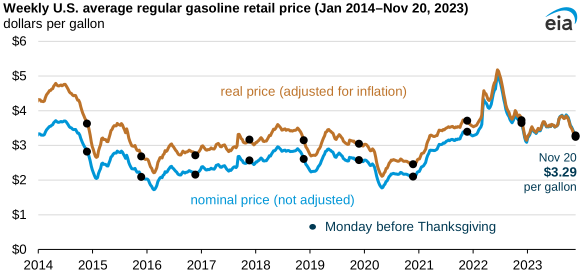
On November 20, 2023, the Monday before Thanksgiving, the retail price of regular gasoline averaged $3.29 per gallon (gal) across the United States, 10% less than the same time last year. After adjusting for inflation (real terms), retail gasoline prices this Thanksgiving weekend are 13% lower than last year, but they remain higher than pre-pandemic levels for the third year. This Thanksgiving, the American Automotive Association (AAA) forecasts 55 million people will travel 50 miles or more for the Thanksgiving holiday, a 2% increase compared with 2022.
The Strait of Hormuz is the world's most important oil transit chokepoint
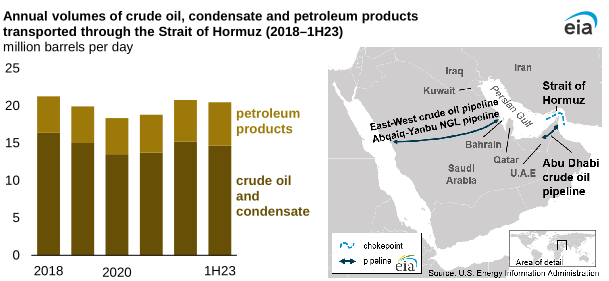
Note: 1H23=first half of 2023.
The Strait of Hormuz, located between Oman and Iran, connects the Persian Gulf with the Gulf of Oman and the Arabian Sea. The Strait of Hormuz is the world's most important oil chokepoint because large volumes of oil flow through the strait. In 2022, its oil flow averaged 21 million barrels per day (b/d), or the equivalent of about 21% of global petroleum liquids consumption. In the first half of 2023, total oil flows through the Strait of Hormuz remained relatively flat compared with 2022 because increased flows of oil products partially offset declines in crude oil and condensate.
Natural gas combined-cycle power plants increased utilization with improved technology
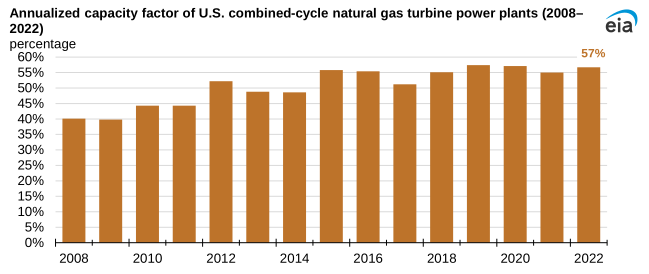
The average utilization rate (or capacity factor) for the entire U.S. fleet of combined-cycle natural gas turbine (CCGT) electric power plants has risen as the operating efficiency of new CCGT units has improved. The CCGT capacity factor rose from 40% in 2008 to 57% in 2022. Increased efficiency improved the competitiveness of newer CCGT units against other fuel sources and older CCGT units.