The Queen's own pirates: Ship which 'plundered thousands in treasure for Renaissance England' found under the Thames after 400 years

- Details
- Category: General
- Published on Sunday, 31 August 2014 22:59
- Hits: 1860
- Officially the Cherabin led an honest existence trading with Turkey in 1500s
- But it led sinister double life - stealing more than £2,000 as state pirates
- Tax on treasure filled coffers of England's courts and rich private 'sponsors'
- It allowed England to wage war on Spain without formally declaring it
- Story came to light after 400-year-old wreck was raised near London in 2003
- Experts in London and Denmark spent a decade analysing the remains
- Now they reveal evidence their wreck and Cherabin were one and the same
Historians believe they have raised England's only surviving 'state pirate ship' from the bottom of the Thames estuary after 400 years.
Most of the time the Cherabin led an honest existence, trading between England and Turkey for the Levant Company before it sank fully-laden in a storm in 1603.
But behind this peaceful image lay a sinister double life - plundering other nations' traders in 'terrorist' raids which were signed and sealed by the High Court of Admiralty.

Find: Historians believe they have raised England's only surviving 'state pirate ship' from the bottom of the Thames estuary after 400 years. The wreck (pictured) was found 10 years ago with few clues to its identity
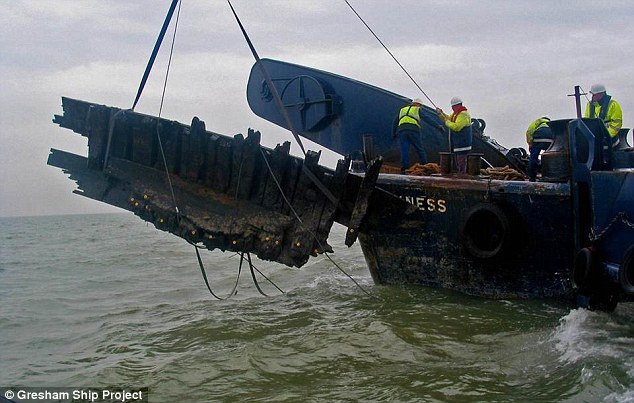
Historic: The wreck was rediscovered in the Thames estuary near Herne Bay, Kent, and is believed to have sunk during a fierce storm in 1603 as it left London fully-laden with goods to trade with the rest of the world
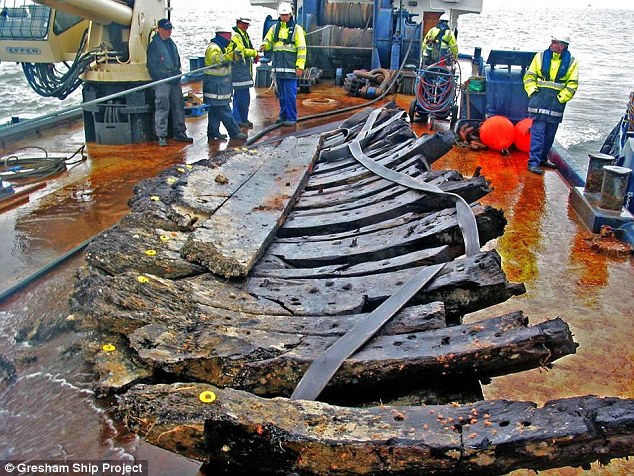
Huge: The ship was left in pieces but originally weighed 160 tons and measured 80ft long and 25ft wide
The Cherabin was one of 70 'privateers' - state pirate ships - which stole £97,000 under the reign of Elizabeth I, more than the famous pirates of the south west put together.
The spoils were then divided between rich English sponsors and the courts, which claimed a hefty cut of the winnings as a tax.
In the case of the Cherabin, the ship travelled to the Azores to steal more than £2,000 in unspecified 'prizes', sugar, hides, ginger, sarsaparilla and brazilwood.
Much of the treasure was owned by merchants from Spain, with whom England was fighting a war that was never formally declared.
Until now historians believed they had never found the remains of any privateers, most of which met grisly ends on the high seas.
But that changed after a 400-year-old vessel was dug up from the bed of the Thames estuary a decade ago in what researchers described as the biggest find since the Mary Rose.
After 10 years painstakingly combing over the ship's mud-caked artefacts and disintegrating beams, archaeologists now say they have strong clues it and the Cherabin were one and the same.
Dr Gustav Milne, an honorary senior lecturer at University College London's Institute of Archaeology who led the project, said the similarities were striking.
Both ships were a similar size and age, both sank fully-laden as they left London, both were armed merchantmen, and both had evidence which pointed to them losing their sails and rudders.
'I think there's a very good chance that the Gresham Ship was actually the Cherabin', said Dr Milne.
'We know the Cherabin was drifting in a peculiar way because it lost its rudder and sails. Interestingly we didn't find a rudder and our ship was strangely orientated on the sea bed.
'If our wreck is indeed the Cherabin, then it probably is the first merchantman of that era yet recovered that led the double-life of honest trader and ruthless privateer.
'Privateering was state-sponsored terrorism formally sanctioned by the High Court of Admiralty, conducted by merchant and private shipping on the high seas - and therefore lying outside the contemporary definition of a declaration of all-out war between two sovereign states.
'In effect, England declared war on Spain without declaring war on Spain, not using expensive armies and avoiding invasions and unwinnable land battles, but by using privately-owned ships sponsored by private backers who would get a cut of the "profits".
'The rest was then collected by the High Court of Admiralty as a "tax".'

Reign: The Cherabin was one of 70 'privateers' - state pirate ships - which stole £97,000 under Elizabeth I
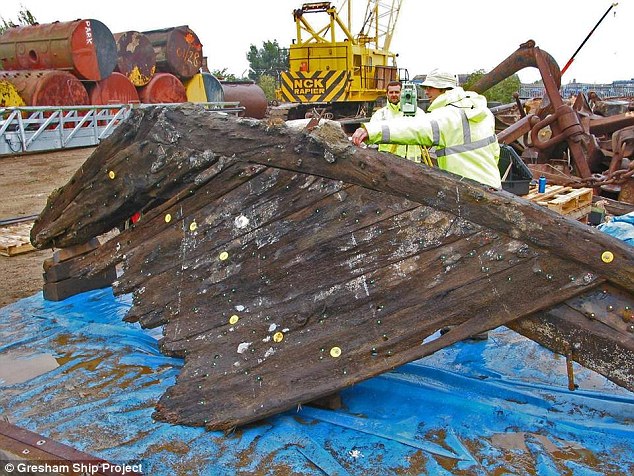
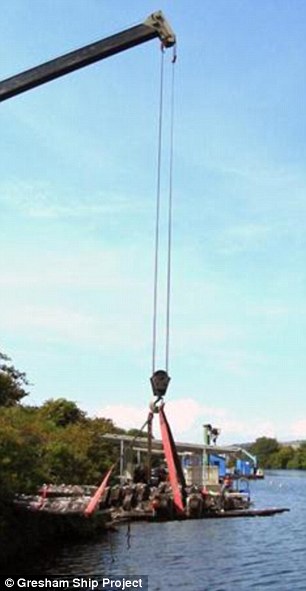
Study: Divers helped raise the ship's skeleton from the murky waters around Girdler Sand near Herne Bay, Kent, and brought it to Portsmouth before samples were sent to be studied in Denmark and London
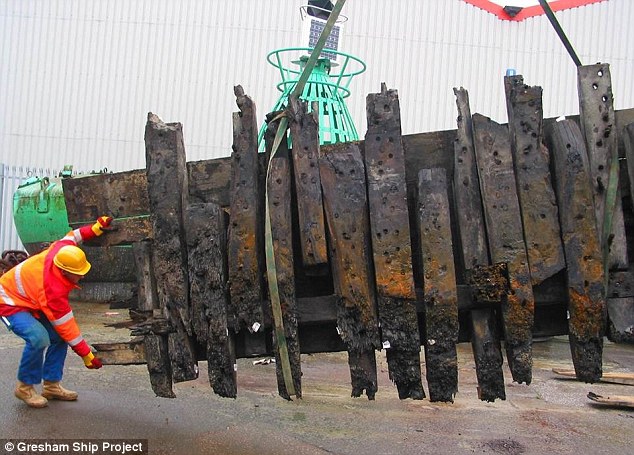
Big job: A workman carefully unloads one of the huge sections which was raised from the Thames estuary

Fragile: The wreck could not be kept out of the water for long because it would begin to decay in the air

Careful study: Like the Cherabin, the Gresham ship was aligned unusually on the sea bed (pictured in diagram)
The historians make clear that they will never be completely sure if they have the right ship.
Port records from the year of the Cherabin's sinking, which would have included its cargo and other details, did not survive and the remains are too disintegrated to prove its origin conclusively.
But details of its final days were recorded partially in court records, because its owner brought legal action over the sinking after he claimed the estuary channels were not properly marked out.
And the historians insist the remains were the most important find since the Mary Rose was raised from the Solent in 1982, after 437 years.
The wreck was originally rediscovered by the Duke of Wellington in the 1840s, whose men found and melted down 2,700 lead ingots, iron guns and lead for money without a second thought for its history.

Significant: Historians described the find as the biggest since the raising of the Mary Rose (pictured), the flagship of Henry VII's fleet which sank in the Solent in 1545. But it was much more typical of ships of the time
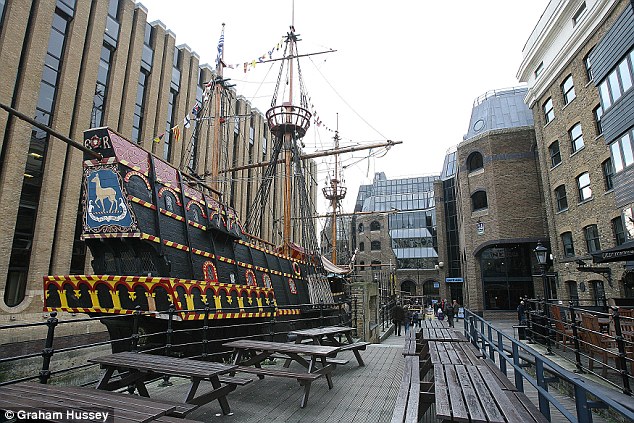
Similarities: Researchers said the ship was similar to Sir Francis Drake's Golden Hinde (replica shown)

Clues: The wreck was named the Gresham Ship after the initials of Elizabethan businessman and scholar Thomas Gresham were found on one of its 7ft cast iron guns. He helped found the Royal Exchange in 1571
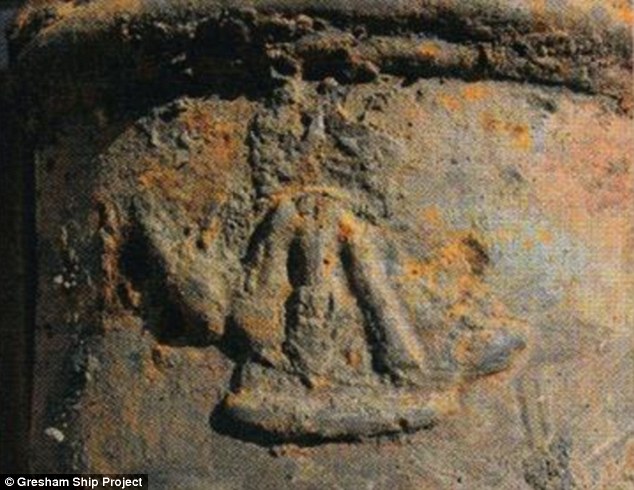
Cannon: An emblem of a grasshopper on the gun. The ship's timbers were felled in 1574, historians believe
After that, the ship's existence was largely forgotten until workmen for the Port of London Authority were dredging the Thames estuary in 2003 to build a £1.5billion container port in Tilbury, Essex.
Divers helped raise the ship's skeleton from the murky waters around Girdler Sand near Herne Bay, Kent, and brought it to Portsmouth before samples were sent to be studied in Denmark and at University College London.
Over several years historians confirmed they had found an armed 16th Century merchant ship, weighing 160 tons and measuring 80ft long and 25ft wide with a 60ft keel.
Its timbers were dated to 1574 and it was similar to the Golden Hinde, the galleon Sir Francis Drake used to circumnavigate the globe in the 1570s.
Eventually they named it the Gresham Ship after Sir Thomas Gresham, the legendary scholar and gunmaker who founded the Royal Exchange in 1571 - and whose initials were found on one of the ship's 7ft cast iron guns.
Unlike the Mary Rose, which was much larger and heavier than average ships in the 1500s, Dr Milne said Gresham's ship was a typical example of London merchantmen of its day.
They traded with France, Spain, North Africa and Constantinople, exploring the world in perilous conditions. Some 34 were commandeered to defeat the Spanish Armada in 1588.
Dr Milne said the research had been excruciatingly slow.
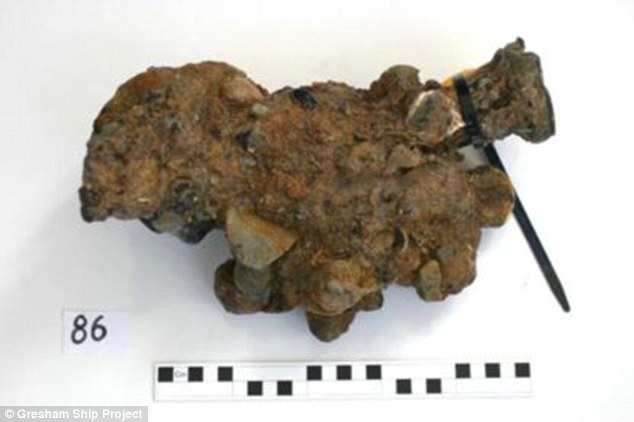
Caked in silt: The historians had a painstaking task to work out which artefacts on the ship were worth saving
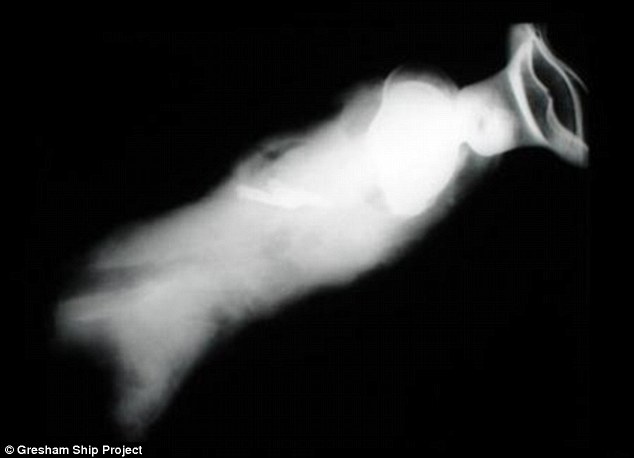
Scientific: They used X-rays to discover the identity of each artefact under the sand - in this case a bottle
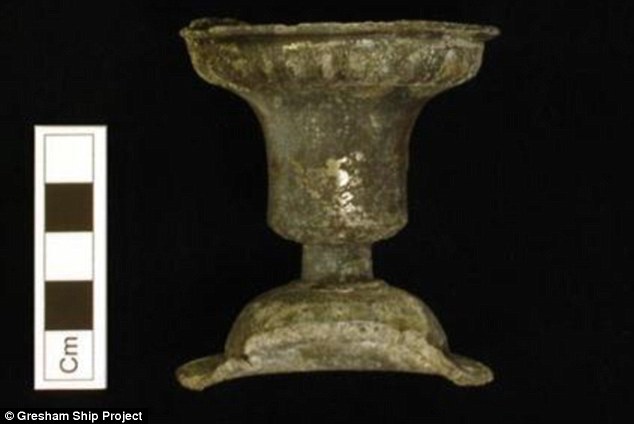
From the captain's table: The team found this ornate salt cellar concealed under centuries of sediment and silt
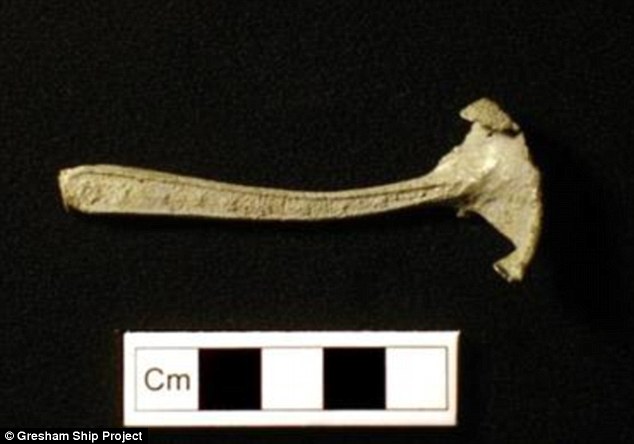
Relics: The researchers chipped away at each of the artefacts from the ship, which were covered in silt
'A lot of the things we found, we didn't know what they were because they had come up covered in sand and gravel,' he said.
'We X-rayed them and painstakingly chipped away at the silt until we found what was underneath. There were boots, spoons and a salt cellar straight from the captain's table.'
The team also found ingots of lead and tin and Kentish ragstone ballast in the cargo hold, along with a powder chamber for an iron gun.
The ship's oak timbers have now taken their final journey from a Navy torpedo testing lake to the National Dive Centre in Stoney Cove, Leicestershire.
Preserved by the water, they are now part of an 'underwater museum' which can be explored by the site's 30,000 trainee divers each year.
The researchers hope to put the artefacts on display at Southend Museum in Essex from 2018.

Heritage: One of the ship's 7ft cast iron guns is lowered into a trough to help protect it from the elements

Photos copyright and courtesy of Wessex Archaeology.
For more information visit Gresham College's website.
Share or comment on this article
Read more: http://www.dailymail.co.uk/news/article-2724651/The-Queen-s-pirates-Ship-plundered-thousands-treasure-Renaissance-England-Thames-400-years.html#ixzz3C0vOpMJx Follow us: @MailOnline on Twitter | DailyMail on Facebook